You’re not new at this. You know how to prioritize. You know what good leadership looks like.
But in a constant fire-drill environment, priorities don’t act like priorities. They act like suggestions.
Here’s what’s happening: when everything is marked “urgent,” people lose the breathing room to look at options, compare tradeoffs, and stick to a plan long enough to finish. So the team starts defaulting to whatever is loudest, newest, or easiest to defend.
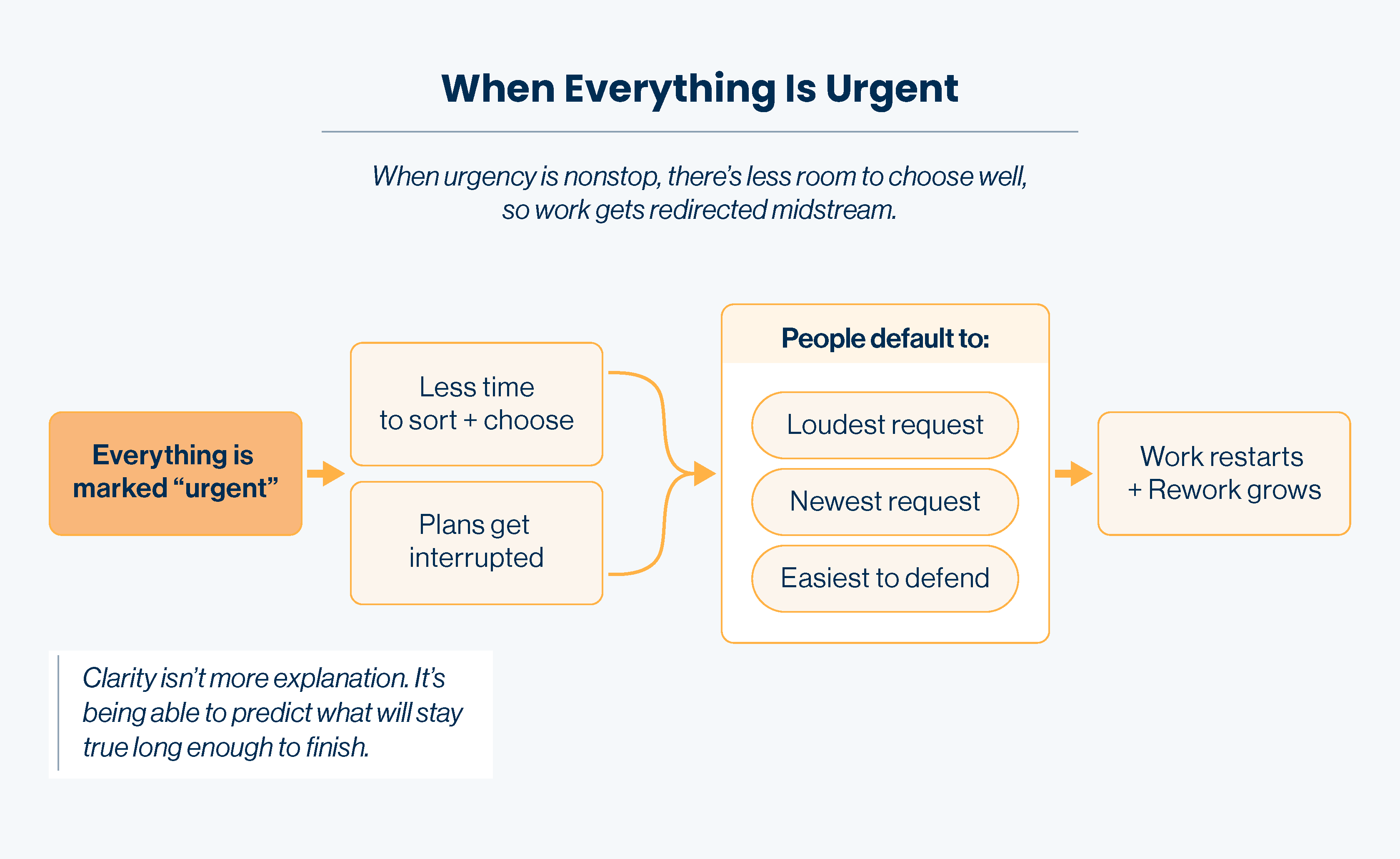
“In this context, clarity isn’t more explanation—it's the team being able to predict what will stay true long enough to finish the work.”
That’s why work starts feeling messy even when goals are written down.
If the “top priority” can be interrupted by anything labeled urgent, then it isn’t really the top priority. It’s just the thing we hope gets done.
When normal urgency turns into nonstop urgency
Urgency itself isn’t the enemy. Occasionally there’s a real deadline or a real issue, and the team rallies.
The trouble starts when urgency becomes the default setting. Three signs show up early.
Sign #1: Messages feel like emergencies
You start seeing:
- After-hours messages becoming normal
- People expecting fast replies without ever saying it out loud
- More checking “just in case,” even when nothing new has happened
A quick self-check:
“If I don’t answer fast, will someone assume I’m dropping the ball?”
If the honest answer is “yes,” your team has quietly learned that fast replies equal reliability. That creates a lot of noise and pulls attention away from real work.
Sign #2: The day breaks into tiny pieces
You might be busy from morning to night and still feel like you didn’t finish anything.
- Too many interruptions
- Too many quick pivots
- Meetings packed back-to-back with no time to restart
So the workday becomes many small starts and not enough real finishes.
Sign #3: You’re “off,” but your brain isn’t
This is the looping-thought phase.
- You stop working, but you keep thinking about what you missed
- You replay conversations
- You worry about what will blow up overnight
A simple prompt:
“When was the last time I finished one meaningful piece of work without being interrupted?”
If you can’t remember, that’s not a personal weakness. That’s what nonstop interruptions do.
Why things fall apart even when goals are written down
This is where teams get stuck. Leaders ask for “better prioritization.” Managers try to write cleaner plans. Senior ICs try to be more organized.
But nonstop urgency changes how people behave.
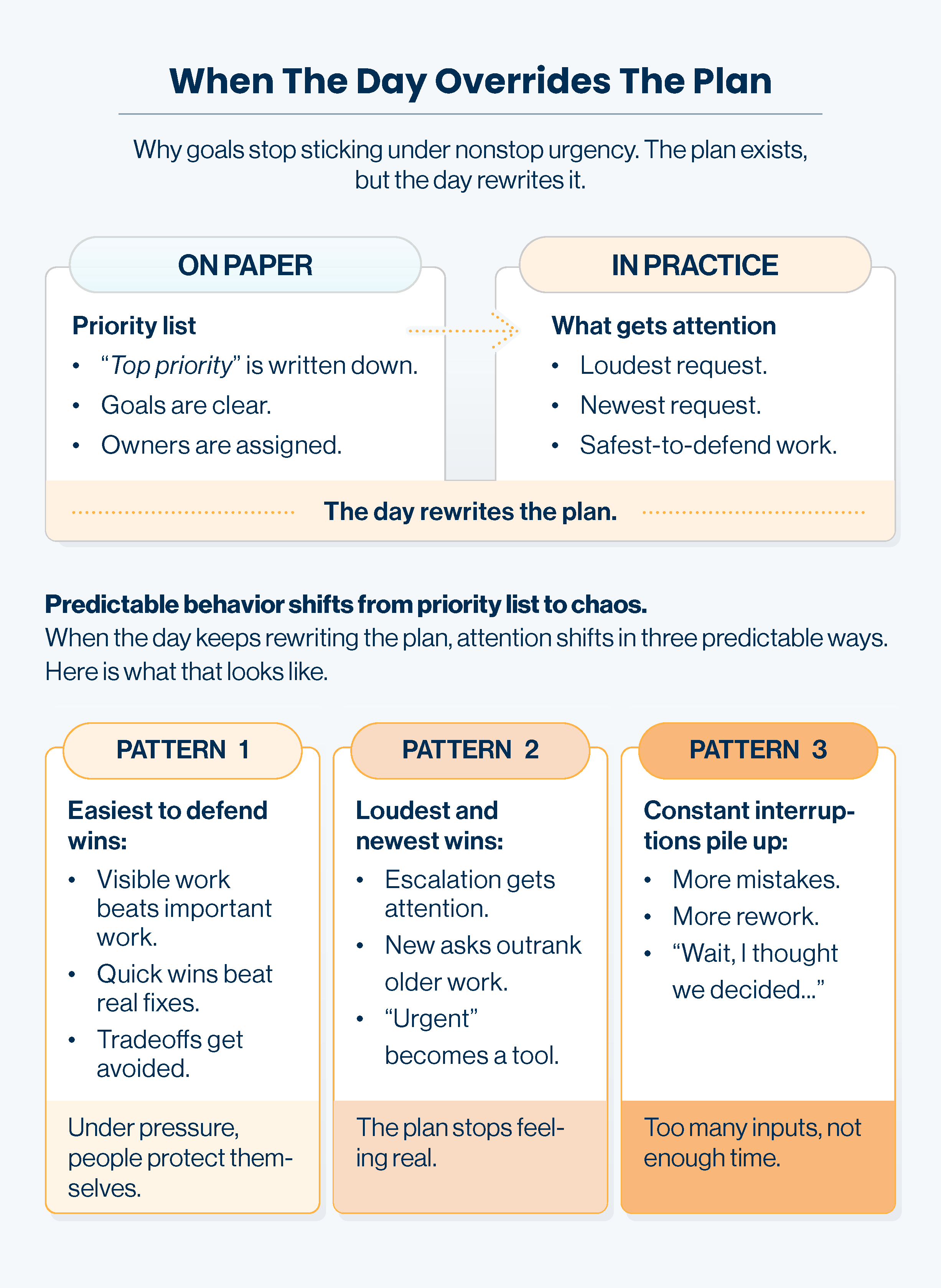
Pattern #1: People choose what’s easiest to defend
When pressure is high, people start asking, “What choice is least likely to get me blamed later?”
So you see:
- Visible work beating important work
- Quick wins beating real fixes
- People avoiding tradeoffs because tradeoffs create risk
Most people are just trying to make the “least risky” choice with the time they have.
Pattern #2: The loudest and newest request wins
Even if a plan exists, the day keeps overruling it.
- Whoever escalates hardest gets attention
- Whatever just arrived feels more important than what’s been sitting for a week
- People learn that “urgent” is a tool, not a fact
So the team stops trusting the plan, because the plan doesn’t survive the day.
Pattern #3: Constant interruptions pile up
Constant pings, switches, and coordination eat the brain’s “scratch space.”
So you see:
- More mistakes
- More rework
- More “Wait, I thought we decided…”
When people say, “I can’t think,” they’re often describing a real condition: too many inputs, not enough time to process.
Three things that shrink your ability to choose and finish (and small fixes that help fast)
You don’t need a total culture change to get relief. You need one or two constraints loosened enough that the team can finish work again.
Constraint #1: Too much started at once
When everyone is juggling too many tasks, everything slows down.
Small fix: put a cap on how many active work items can be in flight at the same time (especially at the bottleneck).
Useful line: “We’re finishing before we start something new.”
This isn’t about doing less forever. It’s about finishing on purpose.
Constraint #2: Anyone can interrupt anything at any time
When every message can derail the day, focus becomes impossible.
Small fix:
- Decide what counts as a true interrupt
- Decide where interrupts go
- Set response windows for everything else
This is how you stay responsive without letting the day become chaos.
Constraint #3: A calendar that chops the day into confetti
Meeting density steals time, but it also steals the ability to restart.
Small fix:
- Cut one recurring meeting or shorten it
- Move status updates to async
- Add small gaps between meetings (even 10 minutes)
You can’t do serious work in five-minute scraps.
A simple sequence that usually creates relief quickly
If you want an order:
- Cap how much is started
- Set interrupt rules and response windows
- Reduce meeting chopping
- Publish what won’t be started this week
That last one is key. It makes your plan real.
“Be responsive” vs “make good calls”
Some workplaces truly reward fast replies. That’s real. And sometimes you do need to move quickly.
The problem is that instant replies are not the same as fast decisions.
When leaders answer everything immediately across many threads, three things often happen:
- Everyone starts expecting immediate replies
- Interruptions spread
- People make “good enough” calls that get reversed later
Speed that creates rework isn’t speed. It’s extra laps.
A steadier option is a protective rhythm:
- Make non-urgent decisions at set times
- Keep the week’s focus small enough that people can remember it
- Set a simple after-hours rule, even if it’s not perfect
Responsiveness is less about being a hero and more about setting the system up to work.
Two simple tools you can use without adding a bunch of process
1) A tiny “are we slipping into fire-drill mode?” tracker
Pick one measure in each group and look at it weekly.
Reply pressure
- After-hours messages per week
- % answered within 30 minutes after hours
Day fragmentation
- Longest uninterrupted work block most days
- Number of calendar blocks per day
Interrupt load
- “Quick questions” that turn into calls
- Requests that bypass the normal intake path
You’re not trying to score people. You’re trying to see the conditions.
2) A “not this week” list that protects finishing
Use this format:
- This week we are finishing: ___
- We are not starting: ___
- If something must interrupt, it needs: ___ (clear criteria)
This is how you keep the week from being rewritten hourly.
If work keeps getting messy and reactive, it’s not always because people “don’t understand expectations.”
Often, it’s because nonstop urgency leaves no room to think, choose, and finish. The team starts chasing whatever is loudest and newest. Plans get overridden. Work gets restarted. People get tired.
You don’t fix that by writing a better priority list.
You fix it by giving the team enough breathing room for the plan to hold steady long enough to finish.
If you want one small move this week, choose just one: cap how much is started, set interrupt rules, or cut meeting fragmentation. Any one of those can give the team back some room to do solid work again.

Rumors Are Spreading During a Restructure. Here’s Why.
Your company is changing shape. Teams might move. Reporting lines might change. Some roles might change. Maybe budgets a
When Everything Is Urgent Work Gets Sloppy and Reactive
You’re not new at this. You know how to prioritize. You know what good leadership looks like. But in a constant fire-dr
Join the conversation — create a free account to comment.