
Your company is changing shape. Teams might move. Reporting lines might change. Some roles might change. Maybe budgets are tightening.
And before anything is official, the questions arrive anyway:
“Is our team safe?”
“Did you hear what’s happening?”
“Someone said layoffs are coming.”
You don’t have clean answers yet. Leaders are still deciding. HR is still confirming what can be shared.
Now you’re holding two jobs at once:
- Keep your team steady enough to work
- Keep trust while you can’t share much
What’s actually happening when the rumor spiral starts
When people don’t have reliable information, they look for patterns. They watch calendars. They notice who is suddenly busy. They compare notes with coworkers. They interpret small changes like they’re clues.
That’s not people being immature. It’s people trying to protect themselves.
So rumor control is not about stopping people from talking. It’s about giving them something more reliable than guessing.
The risk most managers fall into
When pressure is high, managers tend to swing between two extremes:
Extreme 1: Over-explaining
You try to answer everything. You fill gaps. You offer “likely” timelines. You soften the uncertainty.
It feels helpful. It also creates landmines.
Extreme 2: Going quiet
You wait until you have “real news.” You avoid saying anything that might change.
That creates a vacuum. And the vacuum fills fast. A steadier middle is simpler:
Share what's been confirmed. Be consistent about when you’ll update.
That’s what calms chaos. Not perfect answers.
The tool: a three-part update you repeat every time
If you want your team to feel less chaotic, give them a predictable format.
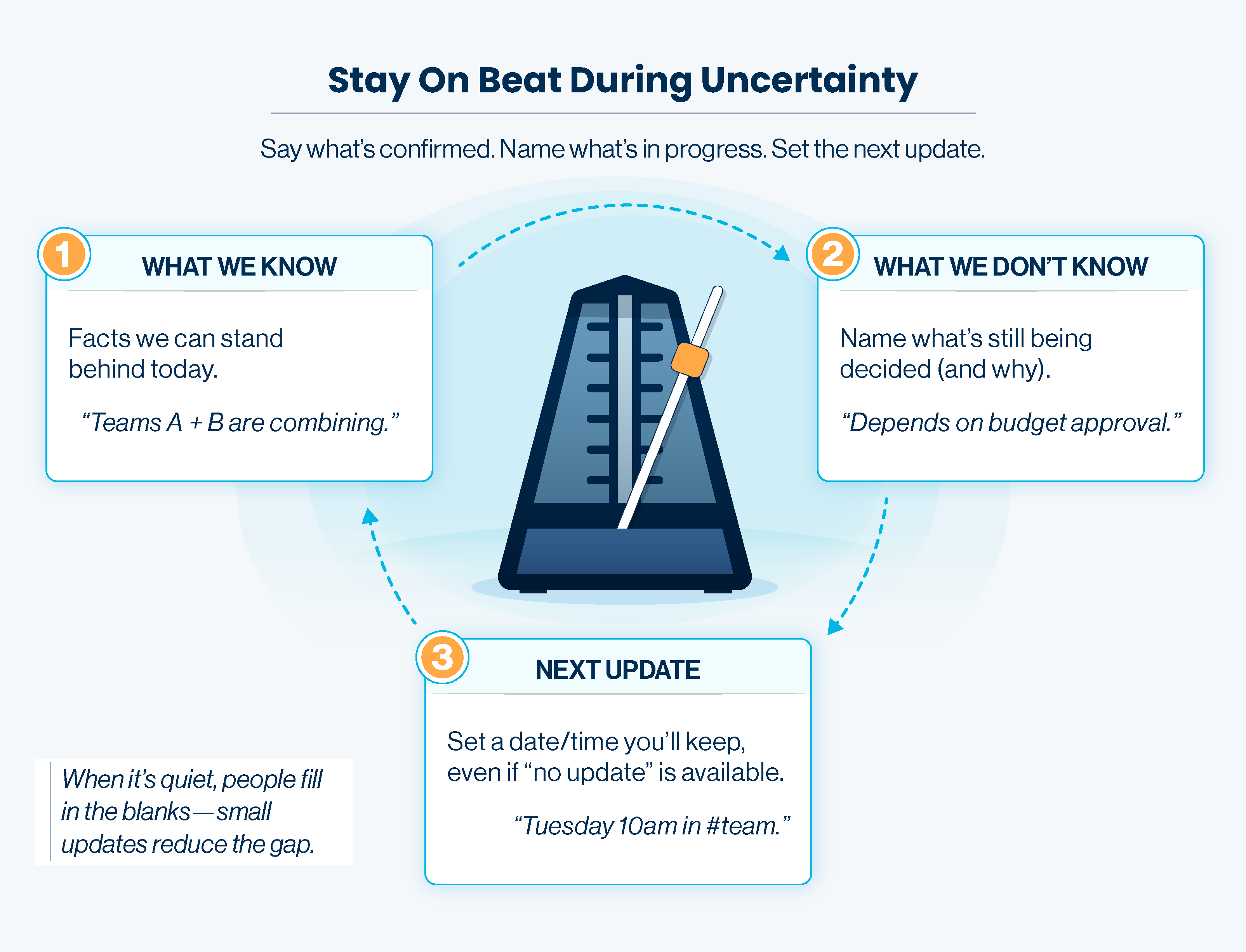
Use this exact structure in meetings, Slack posts, and 1:1s.
1) What’s confirmed
Facts only.
- Decisions that are final
- What is staying the same for now
- What is true today
If you can’t confirm it, don’t put it here.
2) What’s still being worked out
Name what’s open, without trying to make it feel better.
You can keep it plain:
- “This is still being worked out.”
- “This depends on another decision that hasn’t been made yet.”
- “This is being reviewed in a separate process.”
This section matters because it reduces guessing. People stop having to wonder if you’re hiding something.
3) When you’ll update next
This is the credibility piece.
If you aren’t sure you can keep a date, don’t guess. Set a checkpoint you control.
- “Next update is Tuesday at 10 a.m. I’ll share what I know then, even if it’s still in progress.”
- “If something changes before then, I’ll post in our team channel within one business day.”
People can handle uncertainty. They struggle with missed timelines.
A short version you can say out loud
“Here’s what’s confirmed. Here’s what’s still being worked out. Here’s when I’ll update you next.”
That’s enough. It’s calm. It’s repeatable.
A quick way to answer the right question
In restructures, people ask different questions that sound similar. If you answer the wrong one, they leave the conversation with less trust.
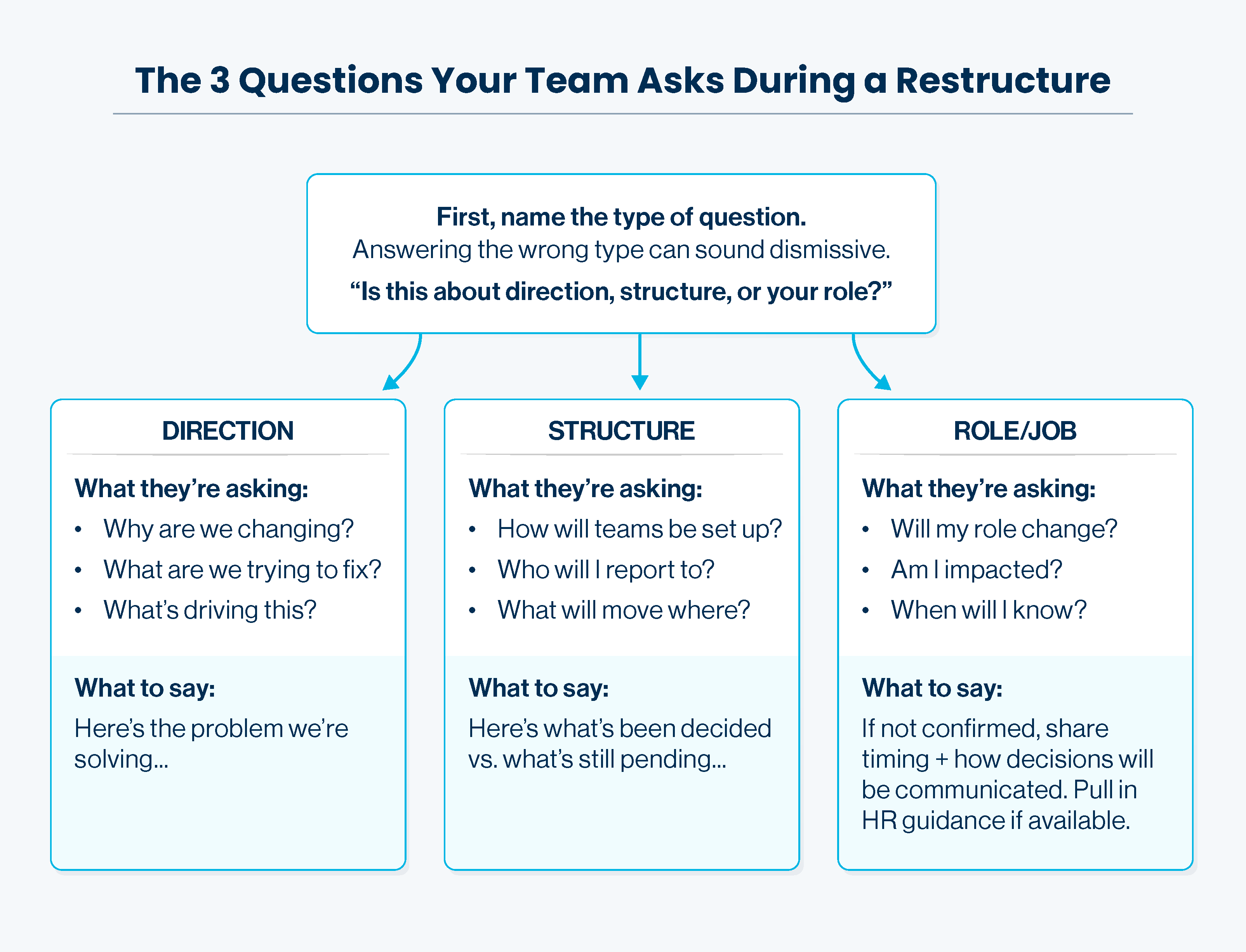
Here are the three most common question types:
- Direction: Why is the company changing?
- Structure: How will teams and reporting lines be set up?
- My role: What happens to my job, scope, pay, location?
A simple line that helps in real time:
“Is your question about direction, structure, or your role? I want to answer the right thing.”
If it’s a my role question and you don’t have confirmed info, be direct without being cold:
“I can’t confirm individual role impacts right now. I know that’s the biggest question. What I can share is how updates will be communicated and when the next checkpoint is.”
If your company has HR guidance on individual outcomes, this is the moment to lean on it. It protects you from guessing.
What to say when someone brings you a rumor
This is where managers often get punished for being honest, because the situation feels like a trap.
Two things to avoid:
- repeating the rumor back (“I heard that too…”)
- dismissing the person (“don’t listen to that”)
Try this instead:
- Acknowledge
“I can see why that’s being talked about.” - Anchor to what you can confirm
“What I can confirm right now is…” - Point to the next update
“If anything changes, you’ll hear it from me in [channel] by [date].”
Slack version (short):
“I can see why that’s being talked about. What I can confirm is [X]. I can’t confirm [Y]. Next update is [day/time] and I’ll post there even if things are still in progress.”
This gives people a place to stand without pretending you have more than you do.
The one rhythm that reduces chaos fast
You don’t need a complicated plan. You need a rhythm people can count on.
If you’re a manager leading a team through this, a simple setup is enough:
- a weekly 15-minute update (same day, same time)
- one shared place where updates live (a pinned post or doc)
- one place to collect questions (anonymous or named)
Rule: Post something on the scheduled day, even if there are no new decisions.
A “no change” update still closes the loop. It tells people you’re not disappearing.
Weekly template:
- Confirmed:
- Still being worked out:
- Next update:
- Where to send questions:
If your company is changing shape, you will not have perfect answers. That’s part of the situation, not a personal failure.
What steadies people is not certainty. It’s a manager who communicates in a way they can predict:
What’s confirmed, what’s still being worked out, and when the next update is coming.
That’s often enough to quiet the loudest stories and make the week feel more manageable.

Rumors Are Spreading During a Restructure. Here’s Why.
Your company is changing shape. Teams might move. Reporting lines might change. Some roles might change. Maybe budgets a
When Everything Is Urgent Work Gets Sloppy and Reactive
You’re not new at this. You know how to prioritize. You know what good leadership looks like. But in a constant fire-dr
Join the conversation — create a free account to comment.